Remix
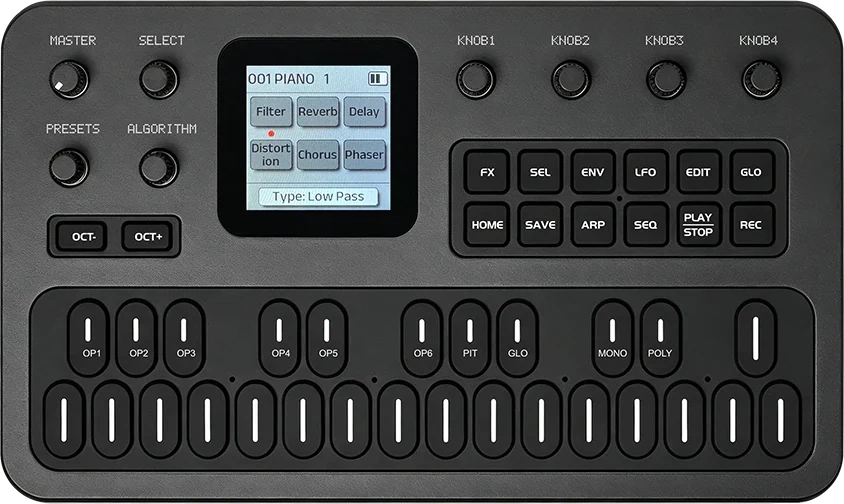
Most affordable synthesizers are sealed boxes. You get the sounds the factory chose, a firmware update now and then, and that is the end of the conversation. The M-VAVE FM-1 took another path. It is a pocket FM synth in the tradition of the Yamaha DX7, it sells for well under a hundred euros or dollars, and a few months after launch its maker published the source code of its firmware. A community took it from there, and the same small box now runs more than thirty different instruments.
We spend our days thinking about what makes a track playable. This one caught our attention.
What the box is
The FM-1 is small enough to sit next to a laptop. M-VAVE (the brand also trades as Cuvave) lists it as a pocket FM synthesizer with six operators, 32 algorithms, 128 presets, an arpeggiator and a 16-step sequencer. It has a built-in speaker and battery, so it works on a sofa, and a stereo output for everything else. Reviewers note that the engine and effects are mono.
Connectivity is generous for the price. MIDI comes in over DIN, USB and Bluetooth, and goes out over USB and Bluetooth. The USB-C port works as both an audio and a MIDI interface, so a computer recognises the FM-1 without a driver. That detail matters later.
The maker opened it
The official firmware, called FM1 Open, lives on GitHub under M-VAVE's own account. The application code is released under the GPLv3 with a linking exception, while the sound engine itself stays a closed binary library. It is a pragmatic split. The part that makes an FM-1 sound like an FM-1 remains M-VAVE's, and everything around it (sequencer, screens, MIDI routing, storage) is open to read, change and share.
The same C sources compile for the device and for the web. M-VAVE's browser workbench previews the instrument without any hardware, updates the firmware, and manages projects, samples and DX7 voices. Classic DX7 patches go in and out as standard SysEx files, so decades of existing FM sounds are one import away.
A hub with more than thirty firmwares
Opening the code did what it usually does. An independent developer in Hamburg runs The Firmware Hub, a catalogue of community firmwares for the FM-1 that is not affiliated with M-VAVE. Every entry has to be open source with its complete source public, and the hub mirrors each package unchanged from its author.
The range is wide. SLOOP turns the FM-1 into a live groovebox, zp12 into a 12-bit sampler and drum machine, X0X into 909 and 808 drums with two 303 basslines, FM-106 into a Juno-106, AMB-1 into a generative ambient machine in the spirit of Music for Airports, and MAKU into an ambience machine for DJ interludes. Most are serious instruments. At least one is a joke, and at least one is a music toy for small children.
Installing one takes a minute. In Chrome or Edge, which speak Web MIDI, you plug the FM-1 in by USB, press Connect, then Install. Nothing to download, no driver. If something goes wrong, holding OCT- while switching the device on puts it back in update mode. Two honest caveats come from the hub itself: it runs no tests or reviews, and each firmware stores your projects and samples in its own way, so back up before you switch.
How much fits inside
Because the source is public, the numbers are not marketing claims. They are constants anyone can read in the code:
- 8 tracks of 64 steps per project, which is four bars of sixteenth notes, with chords, gate, probability, ties and parameter locks.
- 16 project slots on the device.
- 8 sample slots that share about 19.55 seconds of audio, stored at 32 kHz in mono with a compressed codec.
- A library of 128 DX7 voices.
All in, everything a user makes on the official firmware fits in about half a megabyte. That is not a criticism. It is the budget of a pocket instrument, and it shapes what a song can be on it.
Why a song fits as a kit
A full track does not fit. Three and a half minutes of audio at the FM-1's sample rate and codec would need about eleven times its entire sample memory. But a track is not only its audio file. It is a hook, a handful of sounds and a structure, and all three fit.
- The hook as samples. The vocal phrase everyone remembers, two or three drum hits from the real stems, a stab. Nineteen seconds is plenty for that.
- The sounds as DX7 voices. The bass, the lead and the pad, rebuilt as FM patches. Portable too: the same SysEx file opens in Dexed, on a Volca FM or on a vintage DX7.
- The structure as patterns. Intro, groove, break, drop, each a four-bar section in its own project slot, up to sixteen of them.
- The arrangement as MIDI. The FM-1 listens on eight MIDI channels and follows an external clock, so the full song can be streamed to it from a browser or an app and played on its own engine, with no storage limit at all.
That bundle has a name in our world: a remix kit. You load it, you hear the song come out of the little speaker, and the first thing you do is mute the drums, change the bassline and make it yours. It is the old dream of every song as an instrument you can play (the idea MXP4 chased in a browser plugin), in a box that fits in a coat pocket.
It also suits the people who own the music. A kit carries a few seconds of chopped audio and some notes, not the master. It shows a track off without giving it away, and anyone who wants the real stems knows where to find them.
What we are exploring
We are looking at turning tracks from producers on Remix.me into FM-1 kits, in the formats M-VAVE's own workbench already reads, so installing one takes the same few clicks as an update. Before we build anything, we would like to know who wants it.
- You own an FM-1: which track would you load first? Find it on Most Wanted and press I want to remix this, or tell us in the thread where you found this article.
- You make music: would you like your track to become a kit people play on their desk? Create a free producer account and list it. We will build the first kits by hand.